Imagine this scenario. It is Monday morning. Your security team notices unusual activity around a privileged account. Within hours, the issue has reached senior management.
The first questions are predictable: What happened? Which systems are affected? Who had access? Are customer data and critical services safe? Can we prove our security controls were working? Then comes another uncomfortable question: If an auditor walked in today, could we demonstrate that our cybersecurity programme actually works? For many organisations, that is the real test of cybersecurity readiness.
A cybersecurity audit should not simply confirm that policies exist or that security technologies have been purchased. It should provide confidence that the organisation understands its risks, protects critical assets, detects suspicious activity, responds effectively and can produce reliable evidence of those capabilities. For organisations operating in Ghana, this matters even more as cloud adoption, digital services, remote access, third-party platforms and interconnected business systems expand the attack surface.
Ghana’s Cybersecurity Act, 2020 (Act 1038) provides the national framework for cybersecurity regulation and critical information infrastructure protection. Organisations processing personal information must also consider obligations under the Data Protection Act, 2012 (Act 843), while regulated industries may face additional sector-specific requirements.
The leadership question is therefore changing from: “Are we ready for the audit?” to: “Are we ready for the risk the audit is designed to uncover?”
That distinction should shape how organisations approach cybersecurity.
Cybersecurity Audits Should Be About Resilience, Not Paperwork
Consider two organisations preparing for an audit.
Organisation A has hundreds of pages of policies, spreadsheets and screenshots. The documentation looks impressive. But when asked who has privileged access to a critical cloud environment, the team cannot provide a current answer. When asked when disaster recovery was last tested, nobody is certain. Security alerts exist, but ownership for investigating them is unclear.
Organisation B has fewer documents. However, it can quickly demonstrate:
- Who owns critical cybersecurity risks.
- Which systems and data are most important.
- Who has privileged access.
- How suspicious activity is monitored.
- How incidents are escalated.
- When recovery capabilities were last tested.
- Which weaknesses remain unresolved and who owns remediation.
Which organisation is genuinely more prepared? The second. That is the difference between compliance activity and cybersecurity assurance.
Frameworks such as NIST Cybersecurity Framework 2.0 reinforce this broader approach through six functions: Govern, Identify, Protect, Detect, Respond and Recover. ISO/IEC 27001 similarly places risk management and continual improvement at the centre of information security management. Organisations use these frameworks not simply to prepare for an auditor, but to understand whether cybersecurity supports business resilience.
The Cloudware Africa View: Build Assurance Before the Audit
At Cloudware Africa, we believe cybersecurity audit readiness should connect two areas that organisations sometimes manage separately: Regulatory alignment and operational assurance. Regulatory alignment asks “what are we required to protect and demonstrate”, Operational assurance asks “can we prove that our security controls actually work”? A mature cybersecurity programme needs both.
Figure 1: A Cybersecurity Assurance Model for Ghanaian Organisations
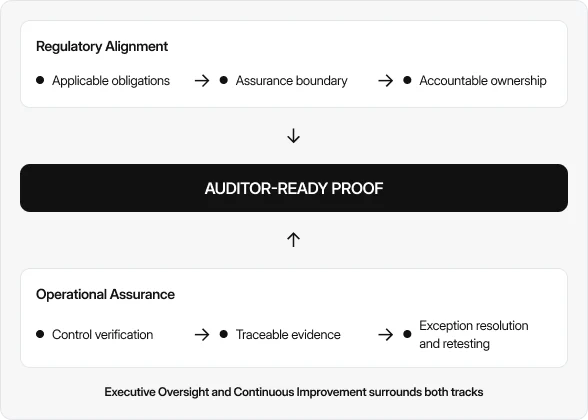
Figure 1. A cybersecurity assurance model for Ghanaian organisations: regulatory alignment and operational assurance converge to create audit-ready evidence, supported by accountable ownership, verified controls, traceable evidence and executive oversight. This model changes audit preparation from a last-minute documentation exercise into an ongoing business discipline.
Five Questions Every Leadership Team Should Ask Before a Cybersecurity Audit
1. Do We Know What We Are Protecting?
This sounds simple until an organisation begins looking. A business may have Microsoft 365, Azure workloads, SaaS applications, employee devices, databases, third-party integrations, remote users and legacy infrastructure operating simultaneously. Some systems may have been introduced without central IT visibility.
The first priority is therefore not creating another spreadsheet. It is understanding scope of the audit. Leaders should know:
- Which services are critical to operations?
- Where does sensitive and regulated information resides?
- Which technology environments support those services?
- Which identities have elevated access?
- Which suppliers could materially affect operations?
If the organisation cannot answer these questions confidently, the audit has already revealed something valuable: visibility is a cybersecurity control.
2. Who Owns the Risk When Something Goes Wrong?
Cybersecurity is often described as an IT responsibility. That view is increasingly outdated. A cyber incident can affect revenue, customer relationships, regulatory obligations, reputation and business continuity. Responsibility therefore extends beyond the security team.
Executives should know who is accountable for major cybersecurity safeguards. For example, who approves privileged access? Who owns customer-data protection? Who decides whether a cybersecurity risk is acceptable? Who coordinates the response when a critical supplier is compromised? Who reports significant cyber risk to leadership?
An audit-ready organisation connects every important safeguard to clear accountability. Without ownership, vulnerabilities remain open, exceptions remain unresolved and security investments become difficult to prioritise.
3. Can We Prove Our Security Controls Are Working?
This is where many organisations discover the difference between having security and demonstrating security. A policy may say privileged access is reviewed regularly, the auditor may ask: ”show me the review”. A backup policy may set recovery expectations, the auditor may ask “when was restoration last tested”? A security platform may generate thousands of alerts, the auditor may ask “who investigates them, and what happens next”? That is why evidence matters.
A useful assurance model asks:
Assurance question
What should demonstrate it?
Why does this safeguard exist?
Applicable obligation and business risk
Who is accountable?
Business owner and operating team
How does it operate?
Process, technology and operating cadence
How is performance demonstrated?
Reliable records covering the review period
How is it independently checked?
Reviewer, validation approach and conclusion
What remains unresolved?
Exception, business impact and residual risk
How will closure be demonstrated?
Completed corrective action and verification, with independent retesting where require
Microsoft environments can help organisations strengthen this evidence chain. Microsoft Entra ID Governance can support identity governance and access reviews. Access to these capabilities depends on the organisation’s licensing. Microsoft Defender for Cloud can provide visibility into cloud security posture. Microsoft Purview can support data governance and compliance activities, while Microsoft Sentinel and Defender XDR can strengthen security monitoring, investigation and response.
But technology alone does not create assurance. The real value comes from connecting technology, governance, people and evidence.
4. Where Would an Attacker Find the Weakest Link?
A good cybersecurity audit should make leadership slightly uncomfortable. It should challenge assumptions.
Perhaps multifactor authentication is enabled for most employees,but not every privileged account. Perhaps cloud workloads are protected, but an old internet-facing application remains unmanaged. Perhaps backups exist, but restoration has not been tested recently. Perhaps employees receive security training – but phishing incidents are not analysed for recurring patterns. Perhaps a supplier has access to sensitive information, but its security posture has never been independently reviewed. These are the gaps organisations should discover before attackers do. Technical security assessments can help identify these gaps before the audit.
Audit preparation should therefore examine areas such as identity, cloud configuration, data protection, third-party exposure, vulnerability management, monitoring, incident response and business continuity. The objective is not to produce the longest possible list of findings. It is to identify the weaknesses most capable of disrupting the business.
5. If an Incident Happened Tomorrow, Could We Respond?
Return to our Monday-morning scenario. A privileged account has been compromised.
Would your organisation know who makes the first decision? Could the security team determine what the account accessed? Could affected systems be isolated? Could evidence be preserved? Would leadership know when customers or regulators need to be informed? Could critical services continue operating? Could the organisation recover? These questions reveal why cybersecurity auditing and incident readiness belong together.
Organisations should regularly test realistic scenarios such as ransomware, compromised administrator accounts, data exposure, cloud disruption and third-party incidents. A written incident-response plan is important. A tested incident-response capability is far more valuable.
From Audit Findings to Business Decisions
The audit should not end when the report arrives. Suppose an assessment identifies ten weaknesses. The wrong question is: “How quickly can we close all ten?”
The better questions are: Which weakness creates the greatest business exposure? Which one could interrupt critical operations? Which one affects sensitive customer information? Which one creates regulatory exposure? Which one could allow an attacker to move deeper into our environment? This is where cybersecurity becomes a leadership discipline.
Every significant finding should have a business impact, accountable owner, corrective action, target date, residual-risk decision and independent retest. That allows executives to direct investment towards the risks that matter most.
Why Cloudware Africa Approaches Cybersecurity Differently
Organisations do not need another provider that simply identifies vulnerabilities and hands over a report. They need a cybersecurity partner capable of helping them understand what the findings mean, which risks matter most and what should happen next. Cloudware Africa’s approach connects cybersecurity assessment with the wider security environment,including identity, cloud security, data protection, threat monitoring, SIEM, XDR, compliance and remediation planning.
That matters because modern cyber risk rarely exists in isolation. An identity weakness can become a cloud compromise. A cloud misconfiguration can expose sensitive data. Poor monitoring can allow an attacker to remain undetected. Weak incident preparation can turn a manageable security event into prolonged business disruption. Cloudware Africa helps organisations look across these connected risks rather than treating each security control as a separate project.
For organisations preparing for an audit, facing increasing cyber threats or questioning whether existing controls are sufficient, this creates a clearer path from: Risk → Assessment → Evidence → Remediation → Resilience
The Real Test Is Not the Audit
Eventually, the auditor leaves. The report is submitted. The findings are discussed. But cyber threats do not wait until the next audit cycle.
Internal teams should retain ownership of strategy, business outcomes and risk. External specialists can provide expertise for assessments, migration, modernisation, security and ongoing optimisation. The objective should not be permanent dependence on a technology partner. A strong partnership should improve the organisation’s capability while providing access to specialist expertise where it is needed most.
That is cybersecurity assurance. And ultimately, that is what audit readiness should deliver.

That is cybersecurity assurance. And ultimately, that is what audit readiness should deliver.
Speak with Cloudware Africa to assess your cybersecurity posture, uncover identity, cloud, data and operational risks, strengthen audit readiness and build a practical remediation roadmap designed around your organisation’s most critical business risks.
Share this article:
Similar blog articles